
How to Mark a Behavior You Want
A lot of people reward their dog…
But they never clearly communicate what earned the reward.
Then they wonder why:
• Training feels slow
• Commands become inconsistent
• The dog seems confused
The reward matters, but the way we mark it tells your dog why they earned it.
⸻
Step 1: Follow the Training Equation
At Elite K9 Service, we follow: Consistency Equals Success.
If a behavior is correct:
• Mark it (e.g. "Good Stay")
• Reward it
Do this every time in the beginning.
Dogs learn through repetition.
The more consistently you mark success, the faster the behavior becomes reliable.
Reward Inside the Command
This is where most people fail.
If you’re teaching a Stay: Do not call your dog out of the command to get rewarded.
Instead:
• Your dog stays
• Reward inside the Stay
• You say, “Good Stay”
The reward should happen where the dog is winning.
Otherwise, you can accidentally teach: “Breaking the command gets me rewarded.”
The command itself should predict success.

Step 2: Mark Partial Wins
Timing matters.
Do not wait until after the behavior is finished.
Mark it while they’re actively doing it correctly.
Even if they’re only partially correct.
For example:
Teaching Focus:
• Dog holds position for one second
• “Good Focus”
• Reward
• Build up duration (e.g., hold Focus for 2 seconds, reward — then 4 seconds, reward, etc.)

Step 3: Build Reliability Slowly
One of the biggest mistakes people make is trying to push a new command too far, too fast.
The dog performs well a few times…
Then suddenly the owner asks for:
• Too much distance
• Too much duration
• Too many distractions
• Taking the leash off too soon
etc.
And the behavior falls apart.
Build gradually.
Reliability has to settle in before you start increasing difficulty.
Holding Accountable
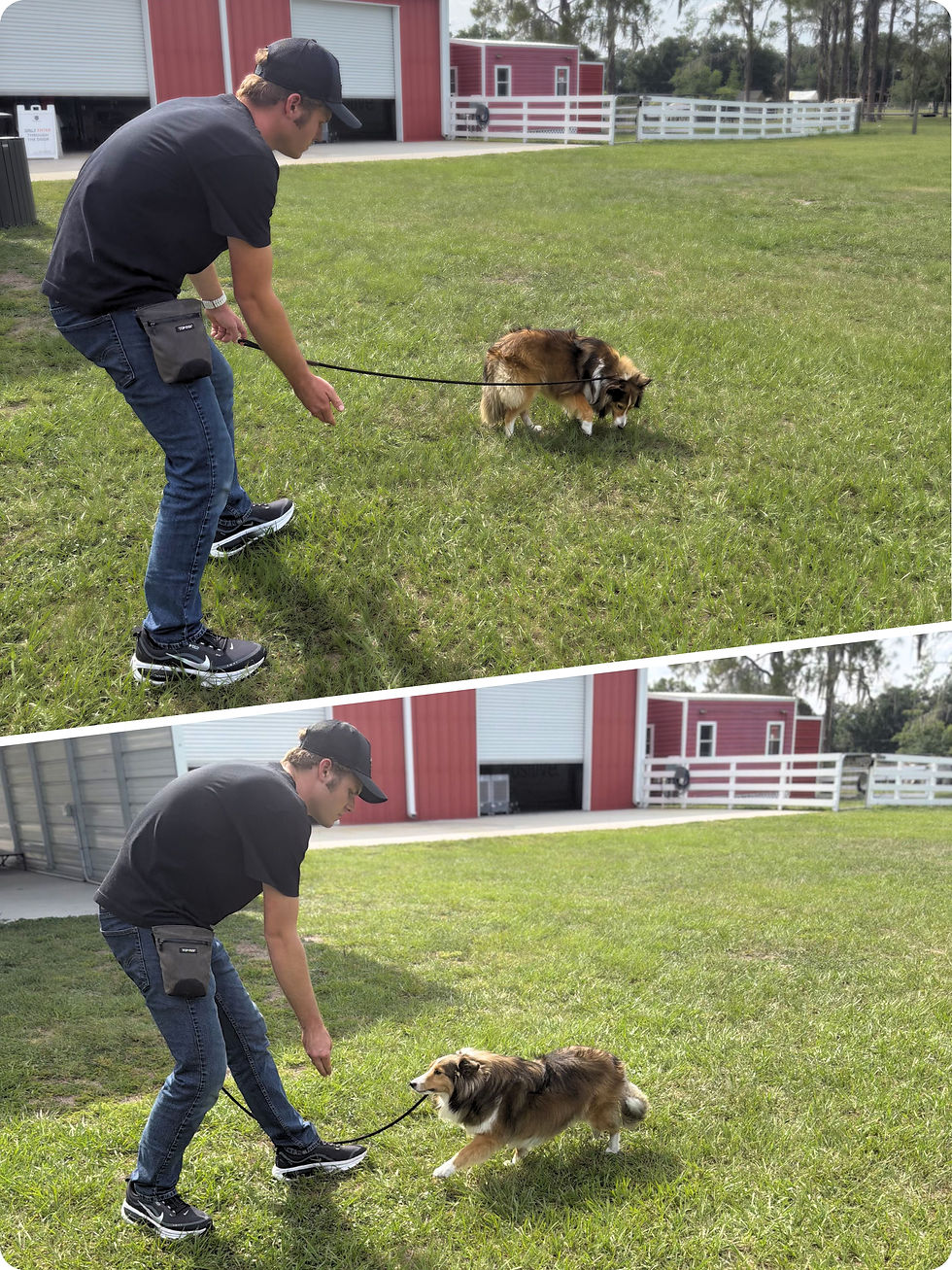
Once you’ve marked a command, you can start holding your dog accountable.
For example:
• You say, "Come"
• Your dog takes a couple steps towards you, then starts sniffing on the ground
• Pick up their leash, give a pop, and say "No"
• Then say, "Come"
• Your dog completes the command, then you say, "Good Come"
Step 4: It’s Okay to Go Backwards
A lot of owners think going backwards means failure... it doesn’t.
Sometimes your dog is still figuring out what they’re supposed to do.
If they’re struggling:
• Go back to the basics.
• Build confidence.
Get some easy wins. Then continue progressing.
After this, you should notice the training progress return to normal.
Strong foundations create reliable commands.

Step 5: Use Hand Feeding for Difficult Commands
When teaching more advanced behaviors: Hand feeding can dramatically speed up learning.
Hand feeding:
• Builds engagement
• Creates positive associations with your hands
• Improves focus
• Makes guidance easier
You can do this during training or day-to-day life.
Many dogs learn faster when rewards come directly from you.

Why This Matters
Most training problems aren’t caused by stubborn dogs.
They’re caused by unclear communication.
The marker tells the dog: “That right there is exactly what I wanted.”
The clearer the communication, the faster the learning.
⸻
Key Takeaway
To properly mark a behavior:
• Be consistent
• Reward inside the command
• Mark the behavior while it’s happening — Use “Good + Command”
• Build reliability slowly
• Correct when needed
• Go back to basics when struggling
• Use hand feeding when appropriate
At Elite K9 Service, we don’t just reward behaviors. We clearly communicate what success looks like. And consistency is what turns success into reliability.


Comments